


The sky darkened and rain was falling in sheets: The 1998 Trail Derailment at Port Douglass
- echs06
- 7 days ago
- 6 min read
Updated: 4 days ago
June 1998 featured a streak of wet weather. Rains saturated the soils, rivers and streams ran briskly. It can be assumed people wished for a stretch of sunny weather. That wish failed to occur on June 25. It not only rained, but poured and most of the rain fell in the afternoon and into the night.
Rainfall records are sketchy, but accounts mention rain totals from two to eight inches of precipitation in Essex, Clinton and Warren Counties. Chesterfield hit the top with the eight inches. With the ground so saturated, the rain had no place to go except into the waterways and down streets.
In Peru, the rushing Little Ausable River destroyed an apartment complex and a dam on a reservoir in the western part of town burst. Streets flooded in Keeseville. Roads washed out, isolating homes.
Small streams became torrents and long-time residents could not recall such conditions.
One of these streams was Little Trout Brook which flows into Lake Champlain at Port Douglass. It’s best known for the 128-foot Buttermilk Falls that is on private property. From that cascade it flowed through a substantial 9x12 arched masonry culvert under the Canadian Pacific (CP, formerly Delaware & Hudson) Railroad tracks located nearly 100 feet above.
One reason for all the devastation was not just the volume of rainfall, but an effect of the massive ice storm that struck the region the preceding January. The ice had created much debris and some had flowed into or partially blocked culverts therefore reducing flow.
Sometime on June 25 a beaver dam burst on a tributary of Little Trout Brook releasing a torrent of water down the slope. The stream was now even more dangerous as it surged through narrow channels and high banks building up velocity. The waters hit the large railroad embankment and its now too-small culvert which had been damaged in flooding from the fall of 1996 that stripped away the outside protective wings and damaged the floor. The culvert therefore had already lost some structural integrity.
The water starting eating away at the sandy soil used back in the 1870s when the railroad was constructed and weakened the culvert’s masonry walls. One engineer later stated the track was “basically being supported by the equivalent of a sponge”
In the midst of the dangerous situation, a new player arrived on the scene at 1:45 a.m. It was Canadian Pacific Train #550 consisting of three locomotives and 66 freight cars proceeding southbound to Albany.
The engineer and conductor aboard the lead engine had no idea of the imminent danger, but had slowed to 30 mph due to poor visibility.
An article in the Press-Republican described what happened next:
“As the first engine rolled [forward, the track] buckled, and the rails bent like reeds. . . . When the second engine passed over, the ground collapsed, . . . With the engineers trapped inside, the still moving locomotives lifted off the tracks. In desperation, one of the engineers pushed the throttle forward, increasing the train’s speed. The sudden jerking motion simultaneously uncoupled the two lead units from the third locomotive and the rest of the train.”
One resident helping neighbors between the railroad and Lake Champlain, first heard the train followed by “grinding metal and the loudest crashing noise ever.”
The engineer and conductor disembarked, most certainly breathed a sigh of relief that their lives had been spared and immediately called the authorities.
Behind the locomotives was a new ravine 100 feet across, over 80 feet deep and a slope of 150 feet. It was massive. Besides the third engine (a 'borrowed' locomotive from the New York Susquehanna & Western) that slid down the slope to rest on its side at the bottom of the slope, sixteen freight cars derailed. Some hung crazily on the cut’s edge, others were scattered on the slope and a few more cars rested at the bottom. A bright orange fiber optic cable dangled down the slope, snapped in the collapse.

New York Department of Conservation (DEC) received a call regarding the accident at 2:01 a.m. When DEC staff arrived at the scene they surveyed the damage and immediately called for more assistance. They found the locomotive next to the brook on its side with a ruptured fuel tank, another freight car carrying 57,000 gallons of whiskey straddled the brook with some of its contents seeping into the water. Authorities officially designated the whiskey as ethanol. When Keeseville Volunteer Fire Department appeared, they detected the odor of leaking diesel fuel and evacuated nearby homes as a precaution. Officials permitted residents to return home by 9 a.m. as the threat abated.

The embankment’s collapse deposited such large quantities of silt and sand into Lake Champlain that a plume of silt was visible for up to ten miles until it settled and the sand created a sandbar at the outlet of Little Trout Brook where it flowed into the lake.
In the morning, cleanup crews arrived to control the 3,000 gallon fuel spill. Booms halted the spread. As for the whiskey, 5,700 gallons of the ‘ethanol’ leaked and the lake water quickly diluted it.

To help clear the site the two locomotives and 49 unscathed freight cars were pulled away from the ravine. Fiber optic service was re-routed.

CP representatives also appeared quickly and optimistically stated everything should return to normal within four days. That estimate was way off. Damage extended beyond Port Douglass. There was a significant washout in Port Kent as well as the destruction of the AMTRAK station in the hamlet for the second time in two years, plus an additional 16 washouts totaling 1,000 feet of track in Essex and Clinton Counties stretching over a 15 mile stretch of rail. Workers placed a preliminary cost estimate of 3 million dollars for all the repairs.
Rebuilding commenced immediately, but nature had other ideas. Hard rains on June 30 and July 1 washed out another 75 feet of the tenuous embankment.
Estimates called for a brand-new culvert, thousands of tons of fill and a secure roadbed with rails and ties. CP hired local contractors to work on the project. Out-of-town firms had their employees stay at the Villa and Grand Prix Motels in Keeseville and hungry workers packed the nearby McLean’s Family Restaurant. It proved an economic boom.
A CP spokesman forewarned “People will be seeing a parade of trucks dumping fill for a while.”
At 7:45 p.m. on July 8 an accident occurred at the work site. Gerald Quefnel of Quebec Province was operating a construction crane moving heavy equipment when the machine “toppled off railroad tracks and slid down an embankment. Quefnel was trapped in the machine and volunteer firefighters “cut the man out of the wreckage." The Canadian received treatment at CVPH Medical Center for cuts and bruises and released. DEC cleanup crews already on the site immediately cleaned up the spill of 30 gallons of diesel fuel.
The washout curtailed the operation of AMTRAK’s Adirondack passenger train between Albany and Montreal. Passengers were bussed between the two cities and station stops in between.
For freight trains carrying loads to Plattsburgh or up to Montreal and beyond it was more of a challenge. Dispatchers sent trains from Albany to Buffalo, crossed the border into Canada, went around the western end of Lake Ontario to Toronto and then onto Montreal. The added mileage added a “day or two” to the normal schedule. Shippers exhibited patience.
There are no records regarding the salvage of the freight cars and their contents. As for the 66-foot long, 144-ton locomotive, work crews were able to right it and maneuver it back to the track north of the washout.
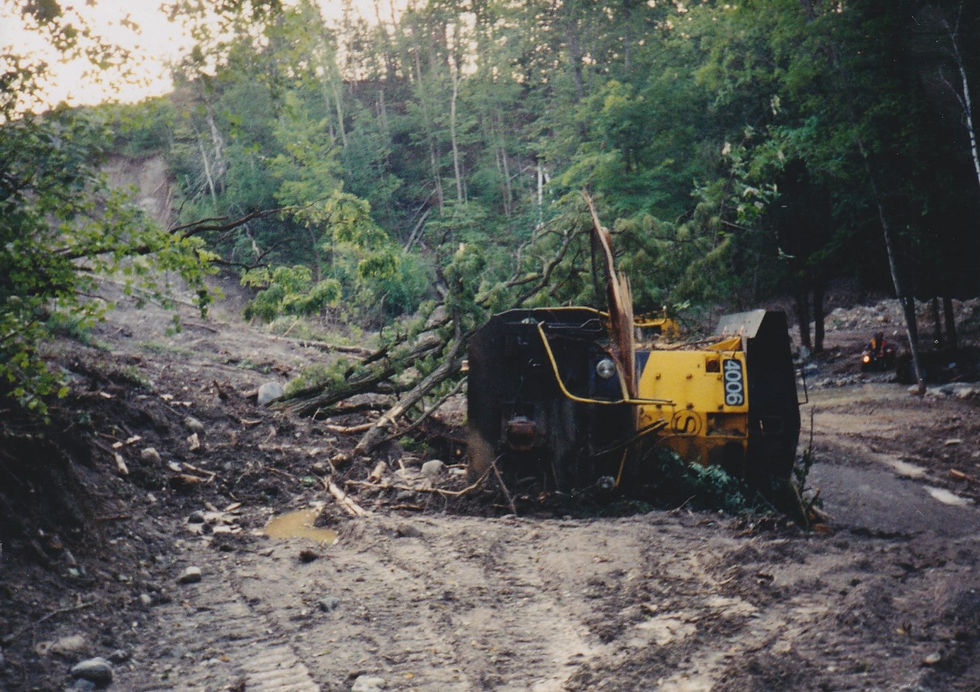
It proved quite the operation and provided entertainment for numerous onlookers. The task proceeded slowly. First, three cranes righted the engine and then placed it on a mammoth 96-wheeled trailer. Then, large tracked vehicles, “looking like they came out of a ‘Star Wars’ movie,” pulled the trailer across the stream to Corlear Bay Road then up the hill on the Port Douglass Road. The ground vibrated. Right before the railroad overpass the machines turned onto a private driveway that paralleled the tracks. The three cranes followed and lifted the locomotive back onto the tracks. There it waited until workers repaired the Port Kent washout to the north.


On inspection, it fortunately was determined most of the damage was cosmetic. The locomotive was pulled to a repair facility in Montreal, repaired and returned to service.
Far from the original estimate of four days, then extended to mid-July, freight operations started up again on Thursday, August 13. Forty-nine days had passed since the washout. To allow for the compression of the new track beds along the tracks, train officials mandated speeds of 10 – 15 mph over the repaired sections.

AMTRAK service resumed northbound six days later on August 19 and southbound the following day. No more busses!
The NYS&W sold the repaired engine to the Providence & Worcester Railroad in 2005, who renumbered it #4003. It remains part of the company’s active roster, now dressed in the P&W’s colors of orange, brown and yellow.
Total expenses totaled 5.5 million dollars and a degree of normalcy finally returned to Port Douglass and the rails through Essex and Clinton Counties


Comments